Category First, View Second
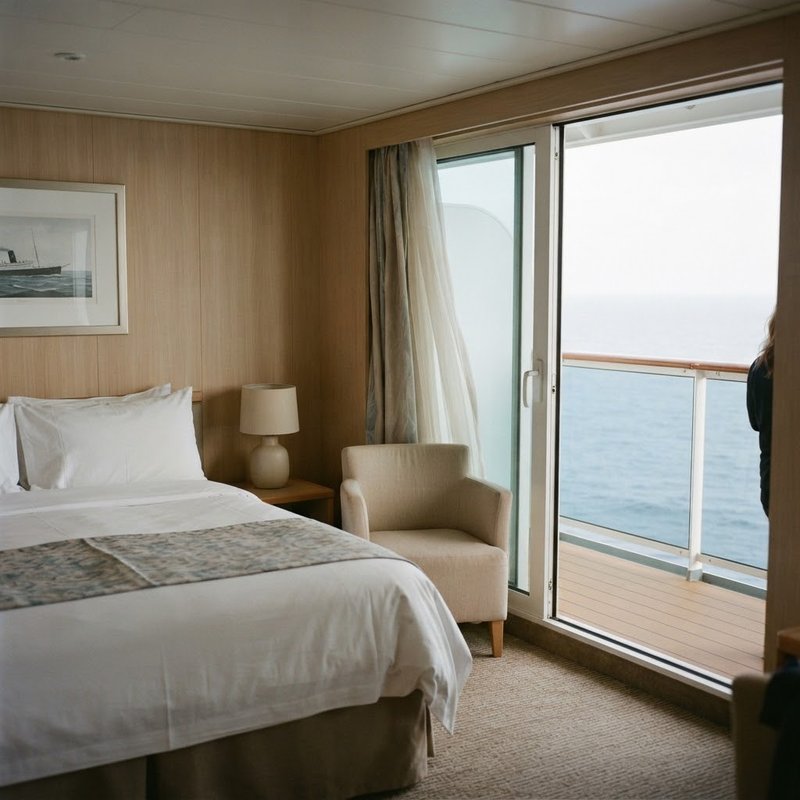
The cabin category decides how the week feels: an inside room sleeps cheapest and stays dark until a light is switched on, a balcony costs more for the twenty minutes most people spend on it, and a suite mostly buys space and a quieter corner of the ship. I book the category first and the view afterwards, because an upgrade within a category can usually be bought later while a deck location cannot.
The trade is straightforward. Moving from an inside room to a balcony on a seven-night sailing adds a noticeable amount per person, and on a week with two sea days the balcony earns that money back in hours. On a port-heavy route, where you leave the cabin at eight every morning, the same money buys a better deck position inside the same category.
Where the Cabin Sits
Two rules cover most of the noise problem: stay midship, and keep at least one public room away from you above and below. Midship moves least in a swell, the lifts are a short walk instead of a corridor away, and a cabin under the theatre or above the galley keeps its evening programme whether you booked it or not.
I read the deck plan before the brochure for three reasons: where the elevators end, what sits on the deck below, and how far the cabin stands from the laundry and the crew doors. On ships where cabins line a single corridor, the end cabins next to the service area are the ones that wake people at six.
Sound carries in two directions as well. A cabin above the atrium hears the live music below it, and a cabin beside the galley hears the early morning delivery whether or not the ship advertised it. Neither shows up in a brochure photograph, and both decide whether you sleep through the week.
Connecting Rooms and Family Blocks
Connecting cabins are the scarcest inventory on the ship, released in small numbers long before a sailing fills, which is why groups of four to twelve people take them first and everything else second. On school holiday sailings I have watched every connecting pair on a deck go before a fare moved once, and families end up two floors apart with a lift ride between them.
The order that works for a family or a small group is the same every time, and it takes ten minutes with the deck plan open before any argument starts. Skipping straight to the view is the step that costs families a door between the rooms later on.
- Count the cabins and the sleeping bodies, then decide the mix of doubles and triples.
- Ask for connecting cabins by number before asking for a category upgrade.
- Confirm in writing which cabins share a door, because the deck plan drawing is approximate.
- Only then look at view, deck and distance to the pool.
When the connections are gone, the fallback is a pair of cabins across the corridor on the same deck, which keeps everyone inside one walk and costs nothing extra. What I would not do is split a group over two decks to save a fare difference; the evenings end early for whoever has the stairs.
The Check Before I Hold Anything
Five questions get answered before a cabin number is sent back to a client, and they take ten minutes with the deck plan open. I run them in the same order every time, because the answer to the fourth often removes the fifth.
- Which deck section is the cabin in, and how many corridors from the lift?
- What sits directly above and below it: cabins, theatre, galley or pool deck?
- Does the cabin have a connecting door, and what is on the other side of it?
- Where are the nearest stairs, the laundry and the crew entrance?
- Does the fare hold the category, or only a guarantee inside it?
The last question decides more bookings than the other four together. A guarantee fare saves money and hands the deck plan to the line, which is a fair trade for a traveller with flexible dates and a poor one for anyone who needs the room next door.
Where a line does allow a cabin number against a guarantee, I pay the small difference and hold the number, because a known cabin on deck six beats an unknown one on a deck with a theatre above it. The whole check then takes one more minute: compare the number on the confirmation against the deck plan drawing, since plans are revised and the confirmation is not.
What I Would Book for a Family of Four
Two connecting cabins beat one large room once the children pass about eight, because the adults get a door that closes and nobody shares a wall with a sofa bed. Start from the family planning page and the group sequence, then hold cabins in that order: location, connection, category.